Monday, 24 February 2020

Old Movies’ Reviews: ‘The Easy Street’, ‘The Immigrant’, ‘The Cure’ and ‘A Dog’s Life’ (I)


by Laura Lai/Review

I googled the other day the words ‘silent movie’, in order to learn some theoretical and technical things and to make even more properly the old films’ reviews. What do you think it resulted? ‘The Silent Movie’ – an American satirical comedy made by Mel Brooks in 1976! I’ve said myself to try again, this time with ‘silent film’. And I’ve got luckier: it was what I was searching.
It is not difficult to realize that ‘silent film’ means a film without a synchronized sound of the dialogues. Otherwise, it would not be called ‘silent’. Instead it makes use of intertitles – the ancestor of the modern ‘sound dialogue’ or ‘subtitles’.
            Some countries prefer dubbed films, others prefer to use subtitles. I personally favor subtitles, because I like to hear actors’ voices. Another reason why I favor subtitles concerns the positive implications that subtitles may have in pushing people to practice reading, particularly in those countries with a high rate of people leaving school, or although in school still less capable to read and write. And what a better motivation than to read the subtitles of the film genre one is passionate about? – I should not have asked, because it seems that there may be a stronger motivation: the driving license written test! J
            I am a great, great film lover in general. When I was a child, in primary and gymnasia school, the cinemas were state owned. Pupils were having free entrance particularly at the morning representations. I watched many movies starting with 10 a.m. They were western, Indian, Soviet films, comedies, dramas…you name it! I think that what I was enjoying then is the same with what I still enjoy, since I would watch a film at any time of the day: I think I have been enjoying watching stories.

A film is a story. There are all kinds of stories. Some embrace detective film stories, others romance film stories, etc. I like them all. The silent film is also a story. I have recently watched on YouTube films made by Charlie Chaplin – the most representative of the silent film: ‘The Vagabond’ (1916), ‘The Pawnshop’ (1916), ‘The Easy Street’, that was not easy at all (1917), ‘The Immigrant’ (1917), 'The Cure' (1917),  ‘A Dog’s Life’ (1918) – all of them around 25 minutes and black and white.
            The plot is usually simple in silent movies. They all have as mandatory scene a chase scene or a fighting one, or both. Although without sound, the silent movie succeeds in communicating even the slightest thought or emotion of the character. Besides the fact that I find that fascinating, I wondered how it succeeds in doing this.
            First and foremost, the lack of sound needed to be compensated by something even greater. This something I am convinced that is the talent of the actors: Charlie Chaplin, as well as Edna Purviance, Eric Campbell, etc. – regular actors in Chaplin’s movies. The actors use their great talent to communicate the whole plot of the film, their thoughts, their feelings regarding other characters and create an enjoyable atmosphere in the middle of the WWI. This reminded me of pantomime (lat. ‘pantomimes’), which means telling a story with the use of hands and it was a beloved genre practiced in the Ancient Rome. The pantomime is a genre in itself with its own requirements: a main actor and several second actors – one of which is the most laughable or the most ridiculous. It was usually played at the end of classic tragedies, in order to improve the mood of the public, which it usually did as it was also accompanied by music.
            The silent film makes also use of a … ‘back stage’ music. Sometimes is a violin, some other times a piano, a whole small or large orchestra, etc. I would argue that for me, as viewer, the music also engages me in being part of the plot and share characters’ emotions and thoughts.
            The third element through which the silent film succeeds in communicating without any word different thoughts and feelings of the characters is, from my point of view, the type of shot. I am not by far the greatest expert in camera shots – I actually think that this is a very technical thing. I can assume that at the beginning of the cinema, when the camera itself was not too old, film directors (like Charlie Chaplin, for example) use it intuitively to tell the public a story and to bring in that personal note of theirs. To me, the hat, the cane and his walk are symbols of Chaplin’s identity of ‘vagabond’ character in the silent film. But in all his movies there is one constant idea that he tries to inculcate in our minds through his art: the gentleman issue with women by helping them, supporting them, understanding them (and when the film allowed animal lover, too). This is the ‘personal note’ of Charlie Chaplin’s movies. Alfred Hitchcock is a super-fine psychologist and he used that in making his scenes – I think that is about 20-25 years ago when I had this great chance to watch on TV a whole series of movies signed by Hitchcock. Quentin Tarantino actually plays with camera, in order to keep our focus more or less consciously on a point where he wants us to get. Charlie Chaplin entertains and silently shows how men should treat women.
            At the beginning of the cinema, in silent films, we have either long shots – in order to have a full picture or close-ups (I think that’s the way they are called). By putting the camera on one of the characters that is actually a very talented and expressive actor, the film director of the silent film succeeds in communicating thoughts and feelings. (to be continued)

Old Movies’ Reviews: ‘The Easy Street’, ‘The Immigrant’, ‘The Cure’ and ‘A Dog’s Life’ (II)


by Laura Lai/ Review

The silent film is a story, but the beginning of the cinematography is itself a fascinated story. I do not find the silent movie as ‘primitive’ or ‘hard to watch’ by the great sound and visual effects or elaborate screenwriting of the modern cinema standards. Not at all! Neither Hitchcock, nor Tarantino, Scorsese, Zeffirelli, Copolla, Spielberg, Cameron, etc. would not have got to this level of film (or filming) art, unless somebody at some point pioneered.
            The reason why pioneers like Charlie Chaplin started – meaning their motivation is theirs alone. The way they started, meaning looking at the beginning of the cinema though the modern lenses, is fascinating to me. And even more fascinating is the way modern film directors still find ways to push the boundaries of the modern film even further.
            The film pioneers must have been of strong characters, because … from my observation (for writing purposes) of the way people talk and interact with each other … I nurture this feeling that every generation has its … people that would ask: ‘What?! Are you nuts?! How are you going to do that? You can’t do it! Nobody did that before, and you think that you are going to make it?!’ – a line usually meant to cultivate a seed of doubt in the pioneer’s heart and eventually to demotivate him/her.

Due to the fact that some actors pioneered this film industry, we enjoy nowadays 3D movies and in HD. It is said that from the silent films three-thirds are lost either because they were not properly stored or because the material they were done of was flammable. Anyway, the viewers can still have a good image of people’s life at the beginning the of the 20th century.
            For example, in ‘The Easy Street’ (1916) we have the image of those times’ street violence. The film is following the rise of a vagabond (Charlie Chaplin) going to a ‘Hope Mission’ to becoming a policeman (following a posted announcement) that brings peace on the street. The film ends with a long shot on the Easy Street’s ‘New Mission’ of peace.
            ‘The Immigrant’ (1917) is the story of all immigrants taking the boat to America. Nowadays, we take the bus or the plane, depending on how far we are going. Both then and now, the immigrant reaches destination ‘broke and hungry’. He finds a lucky coin with which he wants to buy lunch, but in the restaurant he meets again an immigrant woman who was on the boat with him (with her sick mother) and whom he helped before. In the end, they both leave the restaurant with a job offer from an artist they happened to meet there and wanted to employ them. I think a more appropriate title for this film would have been ‘The Lucky Immigrant’. Passing by an office releasing marriage certificates, the immigrant decides to marry the woman he met. This is an interesting scene, because the woman hesitates.
In 1917, when there most probably was a huge pressure from both family and society to be married, for a woman to have such a personality and hesitate … I found the scene memorable. Nowadays, things are different: there is no shame to be unmarried, there is not pressure (depending on culture and on families) to get married, and if women hesitate, each of them have their reasons. It usually starts with ‘I like(d) him’ and the reasons are different: ‘he’s funny’, ‘cute’, ‘great kisser/lover’, ‘nice’, ‘he’s rich’, etc. – as you can assume, for writing purposes, I asked around. What makes this scene memorable is that he also breaks all clichés in 1917 by not sitting in knees – a hypocritical scene, if you ask me, that impresses many women but me, because I’m convinced that all divorces, domestic violence and murder started with a he in knees in front of her. The modern typical such scene shows how he opens a box (or he asks the question with the box opened, as if the box is meant to help him or as if she needs to be bribed to say ‘yes’) – and somehow she is always happy about what she sees inside. I’m personally looking for the best friend – and so far people have been tremendously disappointing – and when I see the knee/ ring scene I always wonder: ‘What if I like him, but I don’t like what I find in the box, how is he going to react?’ – I’m problem solver: If he also leaves there the receipt I may change it with something else of the same genre, but that I may like more. Lucky me that I live in the 21st century – no shame and no pressure to get married! J
            In ‘The Cure’ (1917) I loved also the music. I think in modern times that would be called the ‘soundtrack’. Lovely, isn’t it? The violin soundtrack engaged me as a viewer in the plot of this silent film. The story is that an alcoholic (Charlie Chaplin) gets to a health spring to get cured of this vice by drinking a spring water. He refuses as he came with a huge suitcase – his wardrobe – actually full of alcohol. This liquor somehow gets thrown in the spring and when the alcoholic finally gets convinced by a woman (Edna Purviance) to drink from the spring water and get cured for her sake, the spring waters are full of liquor. This short movie surprised me with many elements of comics that usually take time to think of before the script is written. For a silent movie with a simple plot the script must be relatively short. Then, the elements of comics must be abundant.
            And speaking of scenes that are memorable for a reason or another in silent films, I would not want to miss a sensational great one in ‘A Dog’s Life’ (1918). In this silent film, written and produced by Charlie Chaplin, the viewers have a parallel between dogs fighting for survival and people fighting for survival; then is a saved dog that helps the vagabond to dig out a wallet with dollars and they moved forward, made a family and the dog had puppies. By minute 30 in the movie, the money is lost and the vagabond tries to recuperate them. And the way Charlie Chaplin succeeds in manipulating one of the two drinkers from behind a curtain is amazing. Truly amazing! The kind of talent the silent film needed so that it can pass the test of time.

In a month of February with BAFTA Ceremony Awards, Oscar Ceremony Awards, and during Berlin Film Festival I continued to look at the beginning of the cinematography in order to better understand the way we’ve got to 3D and to HD, how people and society changed … if they ever changed a bit. (the end)

Saturday, 8 February 2020

The 2020 U.S. State of the Union Address. A Short Speech Analysis

Source: www.cnn.com

by Laura Lai/Essay

The picture with Nancy Pelosi – the Chair of the U.S. House of Representatives – ripping the ‘State of the Union Address’ of the U.S. President was all over the news. I am one of those surprised by this picture, because at the beginning Nancy Pelosi wanted to shake hands with the President, then applauded him, and then ripped up his speech. All these in approx. two hours. Afterwards, she explained her last gesture as follows:

            ‘It was the courteous thing to do, considering the alternatives’. (CNN)

But the word ‘courteous’ is explained by the Oxford Dictionary as ‘polite, respectful, or considerate in manner.’ At this point, I am not sure I understand her explanation either, because it does not seem like a ‘courteous’ thing to do with a ‘State of the Union Address’. Furthermore, the fact that these two powerful characters of the U.S. domestic politics have different views on the impeachment procedure is not enough as justification for tearing a ‘State of the Union Address: The state of the Union is one thing and the state of its President is another thing. I had a look at the speech transcript, in order to identify those elements that could have annoyed Nancy Pelosi to such an extent that she tear the speech up.

According to the U.S. Constitution (Art. 2, paragraph 3), the U.S. President must inform the Congress about the state of the union and must recommend the Congress to approve those legislative measures that the President considers necessary. In 2020, the State of the Union was addressed on February 4th.
It starts with an overall summary pointing then what concretely changed: the economic decay is over, the country is not used by other countries in an unfair way, the political promises are kept, etc. Technically, the speech is based on descriptions and on comparing and contrasting. The President says that the economy goes well given the lately economic measures (ex. tax cuts, fair and reciprocal trade agreements, etc.), and by giving even more concrete examples very well structured on gender (women unemployment), age (youth unemployment), race (African-American, Latin-American, Asian-American unemployment), professional category (veterans), and on educational level (with or without high school diploma).
The outcome, the vision of his Administration and the future work follow the structure: from domestic results, to external politics (Venezuela and the Middle East), and from here to air (Air Force) and to the space (Space Force). Then the speech returns to policies: the environmental policy (One Trillion Trees Initiative), the military and defense. By mentioning the killing of the Al-Bagdhadi – the President points his Administration’s fight against terrorists – which is more concrete and more pragmatic oriented – and not against terror – that is quite an abstract, if not slightly ambiguous concept.
Furthermore, from a structural point of view, the speech is also based on comparing/contrasting. While exposing his achievements as head of government and that of his administration, he compares with the previous heads of government and their administrations’ achievements (ex. ‘But unlike so many who came before me, I keep my promises’, ‘But as we work to improve Americans’ healthcare, there are those who want to take away your healthcare, take away your doctor, and abolish private insurance entirely’, etc.).
This explains the use of the first person singular and plural: ‘I made a promise’, ‘I keep my promises’, ‘I signed nine pieces of legislation on human trafficking’, or ‘we have created over half a million new manufacturing jobs’, etc.  Let us not forget that ‘Trump Administration’ implies also the institution of the First Lady. And Donald Trump does not omit mentioning the contribution of ‘our magnificent First Lady’ through her ‘Be Best’ initiative.
Donald Trump himself is in front of the U.S. Congress, in order to inform – as the Constitution requires – and he uses these humble words: ‘I am thrilled to report to you …’. And as the Constitution requires, he also advices the Congress to approve certain pieces of legislation that he thinks necessary (ex. ‘We must also rebuild America’s infrastructure. I ask you to pass Senator Barrasso’s highway bill — to invest in new roads, bridges, and tunnels across our land.’).
            From the wording point of view, the speech uses as a constant reference point ‘since my election’ or ‘three years ago’. And the wording generally translates the statistics: ‘the highest level ever recorded’, ‘transcending anything anyone believed possible’, ‘consumer confidence has reached amazing new heights’, ‘it’s all working’, etc.

It is possible that the thing that was not working was exactly the impeachment procedure. This was already cut off my list of possible justifications for ripping off the speech of the ‘State of the Union’. So, what else could have been? The constant comparing of this Trump Administration to the achievements of the previous administrations, which happened to be Democrat ones, as Nancy Pelosi is? This speech does not ostentatiously insist on comparison, but where the text allows, in the way the text flows, here and there the comparison appears. Besides, the results are really sensational. The President of the United States makes the address and presents his achievements as head of government and of his cabinet. Why should not the Administration enjoy the beautiful words coming from the President? These hypotheses do not explain the tearing. But what exactly did Nancy Pelosi ripped up?
            ‘The State of the Union Address’ is not a presidential arrogance to come in front of the Congress and praise himself with his achievements. The achievements happen to be great and, statistically speaking, some of them greater than ever. The U.S. President Donald Trump fulfilled a Constitutional obligation ‘to inform and to recommend’ the Congress on the state of the union. In a recent interview, the Vice-President Mike Pence said that he had the impression that Nancy Pelosi is tearing the Constitution. I would not go as far as that, because the State of the Union is not the Constitution, but a constitutional requirement, but I agree with what he meant: despite the animosities between Trump and Pelosi, the ‘State of the Union Address’ is not a whatever Trump speech campaign, to which one may react the way s/he wants and tear the speech.
            Making a historical and/or an international comparison, the ‘State of the Union Address’ is comparable to the Queen’s speech in the UK Parliament. It is one thing to tear up such a Queen speech and another thing to rip a Queen’s report on the Swan Upping, in which one may think that she exaggerated with the Swans’ number.

The explanation for the ripping up of the U.S. President’s speech addressing the ‘State of the Union’ does not lay in either the structure, or the wording. Neither in Nancy Pelosi’s own explanation. Another question arises now: If the roles were reversed and the U.S. President Donald Trump was ripping off the speech of the House of Representatives’ Chair, would the Congress have gone for a third impeachment procedure? Thanks God that

‘[o]ur spirit is still young; the sun is still rising; God’s grace is still shining; and my fellow Americans, the best is yet to come! (…) God bless America!’ (‘The State of the Union Address, 2020)

Friday, 31 January 2020

Brexit Is Over. Long Live Brexit!


For a maximized image, click on the picture.

by Laura Lai/Comment

Brexit is over. The partnership between the several-century old United Kingdom and the few- decade old European Union lasted forty-seven years. The last three years were the political ‘divorce’ process. The word ‘Brexit’ is the acronym given to the exit process of the United Kingdom (UK) from the European Union (EU) – a three-year long rolling saga that heated the debates on both the ‘Leave’ and the ‘Remain’ sides. Until today: the 31st of January 2020.

What’s next? In the very short run, a transition period follows and it lasts until December 2020. It is a period that reminds of the UK – US history: ‘the taxation without representation’. It means that the EU law will still apply in the UK until the end of 2020, without the UK being represented at EU level and, consequently, without the UK having a say at EU level on the legislation that applies on its territory until the end of this year.
In the long run, the independent United Kingdom will have the freedom to take its political, economical and commercial decisions like a self-governing country. Furthermore, the Queen Elizabeth II will not anymore be some sort of a ‘governor’ of the British provinces of the European Union (above her there will not be any President of the European Council and any President of the European Commission, or decisions that have primacy over those of her own government), because the British citizen, Elizabeth II, got her country back. The Queen will be again the sovereign of the United Kingdom and Northern Ireland in every sense of the word. Brexit means that the UK will be free to explore the endless future possibilities that lay ahead.

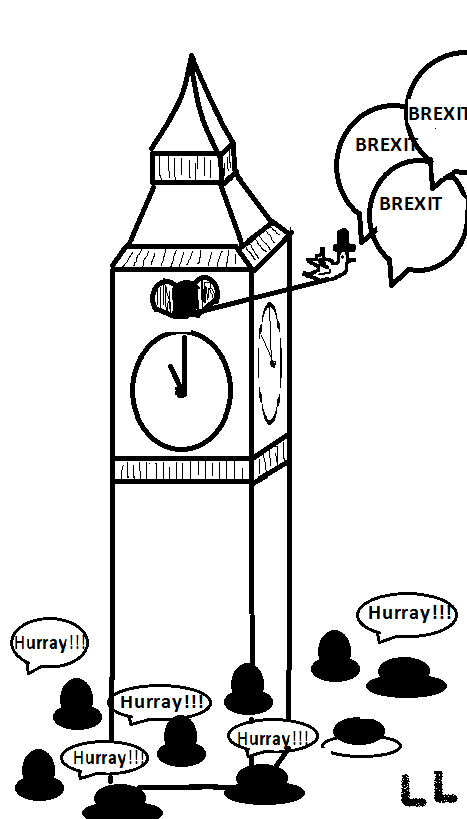
Long Live Brexit! The 31st of January 2020 is the Brexit Day. And Brexit is the UK Independence Day. Or it is the Liberation Day of the United Kingdom from the European Union political project. Regardless of the side each of us took during this ‘divorce process’, I do think that it is a historical moment in British modern history. Therefore, I agree with those who argued that the Big Ben should mark the turning of a new page in UK’s modern history.
Listening the live discussion ‘Should the Big Ben Bong for Brexit?’ broadcasted by the LBC on Nigel Farage Show, I heard the UK Prime Minister, Boris Johnson, saying that the Big Ben, which is under renovation, still lacks a clapper, in order to make the bong. I thought to make a drawing and improvise a ‘singing clapper’, in order to congratulate the UK for its tenacity to get to this point and deliver on the Brexit democratic and legitimate referendum, and in order to wish it:
Happy Independence Day!!!

Monday, 20 January 2020

Happy Birthday ‘Writing Break’ Blog!!!


Laura Lai, coffee break at the National Gallery in London

by Laura Lai/ Uncategorized

Last year today, in a small but comfortable single dorm room in Oxford, I was more determined than ever to do this ‘Writing Break’ blog. I was three days before my drama writing course began – and when I start a course I’m extremely committed to do all my best, in order to complete it the best I can – and I was also applying to jobs that was taking me lots of time. For me, the job hunting has been the greatest time waste especially that I didn’t find any. So, I watched a tutorial on YouTube about the way one makes a free blog and here I was, determined to have it done. In comparison to the job hunting, the blog, as well as the completion of the course, depended fully on me. And I could commit myself to accomplish them. When the blog was online, the satisfaction of having done it entirely by myself was great.

The idea of making the ‘Writing Break’ blog was in my mind for quite some time. I guess that ‘Oxford, January 20th, 2019’ was this blog’s birth place and time. The point was to keep on practicing three writing styles: essays, comments and reviews. I’m also a sketch writing lover and I thought an ‘uncategorized’ section for all other writing styles would be good. The practice material was supposed to come from three fields: politics, culture and sports. Another point was to practice computer drawing. I had this idea of accompanying each of my writings with a computer drawing, because I like drawing and because here I find it relevant: A drawing is the shortest summary of whatever I’m writing about. It’s also quite challenging to draw on computer, but MS-Paint is a good option start.

Writing for a personal writing blog is a great experience. Writing, in general, is a great experience, but the blog allows what I, informally call, a ‘personal note’, some sort of a freedom I have as a writer that I think I can’t enjoy anywhere else.
            For example, I happily connected a speech of Donald Trump at the U.S. Air Force Academy to the movie ‘Top Gun’ or I celebrated 50 years since the first step on the Moon reviewing also the movie ‘Armageddon’. I can’t imagine any teacher or professional allowing me to this in class or in the pages of a magazine without being ‘sanctioned’ for this ‘original association’. Or maybe I’m the outcome of an educational system that generates a general mentality based on ‘you can’t do this!’ It’s crazy, I know. But it can get crazier: The reason why ‘you can’t do this!’ is not a great philosophical and enlightening explanation, but simply the fact that somebody else decides so and you must obey, in order to avoid being punished by diminishing your grades, or whatever system they have (There is a grade for behavior. At least here, I’ve always scored the maximum.). However, ‘because I say so’ or ‘because I want so’ is the cheapest argument I’ve ever heard. I’ve never been interested in learning from people who can’t formulate an argument, but impose their will. Besides, this kind of mentality is not at all democratic. Furthermore, the templates that one must learn and is asked to use almost everywhere I’ve been is meant to help, when a student can’t write, but no rule forbids ‘original association’ of ideas or things, as long as it doesn’t harm anybody. Some people do forbid, instead of encouraging the freedom and the liberty of creativity. No wonder that when I studied Political Sciences in English with some American professors I felt like the happy fish in the water. Furthermore, ‘Old Ties’ drama review allowed me to remind about a good friend and colleague I had in university, while ‘Fair Game’ drama review invited me to a written reflection on this blog. I gave myself the freedom to compare ‘Ben-Hur’ the silent movie (1925) to ‘Ben-Hur’ the animation movie (2003) to the ‘Ben-Hur’ production from 2016, or to write a ‘Football recipe’, or to answer challenges and write a 39-word story on Serena Williams, etc. You bet I love this freedom that this blog gives, without harming anybody, but always trying to add a cheer up spice to our daily life!
            The essays and the comments are usually more documented. And for some, I remember having researched the whole month, such as those on the ‘Who’s the Man in the Southern Border HuMANitarian Crisis?’ or ‘The U.S. Border Crisis: The Deal with Mexico Works, but Can it be Sustainable?’ Other essays started from appalling statistics: I was outraged that 1 in 20 Europeans has never heard of the Holocaust genocide that happened in Europe. But if ‘the Holocaust were a Rock Star’ many people would have known plenty of insignificant details about him or her that are also irrelevant for one’s life security, in comparison to the topic of genocide that is highly relevant for everybody’s life security.
            These last days I have been reading again some of the writings on this blog that I’ve posted during the whole year 2019. Many of the entries are around Brexit and about American internal politics. The reason why it looks so is because I was writing a play on Brexit and I’m planning one on the American internal politics. I basically use the same reading material to write my plays as drama genre and to practice different writing styles on this writing blog. The former I have just finished, but the latter is not yet unfolding in my head, as I’m having now a long trip in mind. I have other priorities – and the full time job remains a top priority in 2020, too – then there are some old manuscripts that require some retouch and a children’s book that needs a follow up.

A writer even when is looking through the window is working. I also like to give a lot of thought to whatever I’m writing before I actually start writing it. And a political play – like the one on Brexit or the one on the American internal politics – requires both reflection time and research. Many details of the research will be left out, but it’s part of a long and enjoyable writing journey.
            In 2020 I will keep on enjoying practicing writing styles on this ‘Writing Break’ blog. I will continue reviewing (old) films and dramas – that I enjoy so much, that I thought to focus only on reviews, but not this year. I will keep on writing comments, essays and reviews based on materials from politics, culture and sports. I’ll try to explore even more the opportunities that an online blog offers. I tried to experience that in December 2019 with the essay ‘From Vaping to Smoking and …’. What I did in terms of format was to write an essay and to add footnotes. Nothing special so far! But when I was a student electronic references were rare, as we were mainly using books and articles (sometimes CDs) as references. The footnotes were written as academic references of online resources should be. However, I didn’t want to disconsider a specificity of the blog in terms of references, meaning the links. Of course, it’s odd to combine in an essay academic footnotes with links! Unless… and that’s what I’ve done in terms of format: all references to data were footnotes, as it should be, but the text was also mentioning one or two international organizations (WHO, for example). I found appropriate to put a link to WHO main page for any further explorations of previous projects, statistics, programmes, etc. I thought to be perfect while taking advantage of an online writing blog resource. It is also in the general framework of freedom of making ‘original associations’ that a personal writing blog can offer that is good for the writing practice and experience, and that it doesn’t harm anybody.
            To sum up, HAPPY BIRTHDAY ‘WRITING BREAK’ BLOG!!! You are 1 year old. And we are growing together!

Saturday, 18 January 2020

Film Review: ‘Eight Below’ (2005)


by Laura Lai/Review

There are some movies that I watched several times and every time with the same pleasure. I guess the reason why I want to see a movie again is the joy that a story on screen offers its viewers, and to me.

‘Eight Below’ (2005) is one of those movies, because I am an animal lover (although I don’t own any pets), particularly dogs and particularly husky. Then I love snow, but only on cinema screen, on TV, on postcards and in cartoons. It’s when I find snow sparkling and truly beautiful! In reality, I find it cold and wet. Last, but not least, it’s the actor in the main role, Paul Walker. Whoever brought him from modeling into the movie world was, from my point of view, an inspired person, because modeling relies on makeup – brought to an art level – but not Paul Walker.
            ‘Eight Below’ is inspired by a true story – another reason why I watch this movie. This Walt Disney movie tells the story of Max, Maya, Old Jack, Shadow, Buck, Truman, Dewey, Shorty, eight dogs who were left at the National Research Center in Antarctica and who fought to survive more than 150 days. In all this time, their master, Jerry Shepard (Paul Walker), was trying to find the resources to return to Antarctica, in order to recuperate the dogs or, at least, to know what happened to them. But a trip from California to the South Pole is not cheap. Then not everybody can understand the bound between a human being and his dogs. This aspect is clearly emphasized in this movie by the scene in which Jerry does not find support at Dr. Andy Harrison (Gerard Plunkett) – once saved by these particular dogs.

I cannot imagine a better choice for the main actor role than Paul Walker, with whose look in the eyes to suggest the internal human sufferance, while thinking of his dogs and refused financial aid to return to Antarctica for his dogs. His heart breaking torment, his dogs’ long fight for survival and the great end make this winter adventure movie such a joy to watch again. Enjoy!